The Brazilian Economic Crisis 1962 to 1973
Hello, everyone in my 3rd Article I am writing about the Brazilian Economic Stagnation and the spectacular come back in the years 1962-73 where during one time it saw stagnation from 1962 to 1967 and then started to make a comeback from 1968 to 1973.
Reason for the Stagnant Brazilian Economy
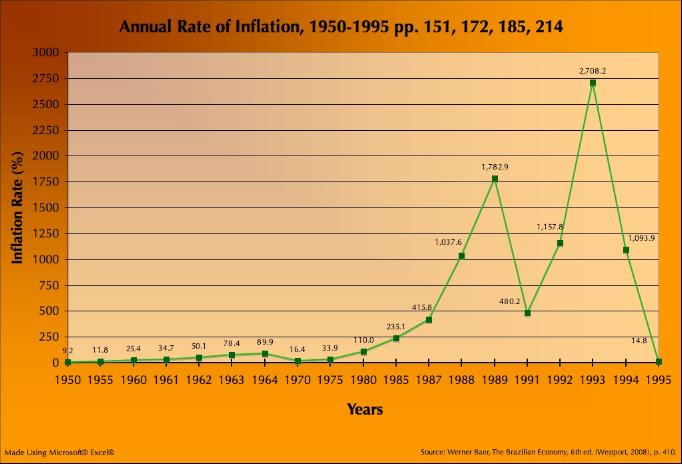
As a result of the problems associated with import substitution industrialization and the reforms introduced by the military regime after March 1964, the Brazilian economy lost much of its dynamism between 1962 and 1967.
The average rate of growth of GDP in the period declined to 4.0 per cent and that of the industry to 3.9 per cent. In part, stagnation resulted from distortions caused by the strategy of the military. Moreover, political troubles negatively affected expectation programmes and weak coalition governments formed to back the tough measures to control inflation and the balance of payments crisis.
The 1964 coup dealt with the political obstacles by forcefully restraining opposition to the military agenda of change. With the objective of transforming Brazil into a modern capitalist economy and a military power, the regime implemented a series of reforms aimed at reducing inflation, at removing some of the distortions of import substitution industrialization, and at modernizing capital markets.
The regime gradually introduced incentives to direct investment, domestic and foreign and tackled the balance of payments problems by reforming and simplifying the foreign-exchange system. In addition, the regime introduced a mechanism of periodic devaluations of the cruzeiro, taking into account inflation. Finally, the military government adopted measures to attract foreign capital and to promote exports. It took steps to expand public investment to improve the country’s infrastructure and later to develop state-owned basic industries.
Too much of military dependence is bad and examples of countries like Pakistan can be taken for a fact. Although inflation was trying to be curbed there was no concrete measure to save Brazil from the disadvantages of curbing inflation as soon as foreign investments were bought in money circulation was bettered and that took the place of inflation because even to a certain extent inflation is good for the economy as it gives good circulation to the money.
The spectacular growth of the Brazilian Economy
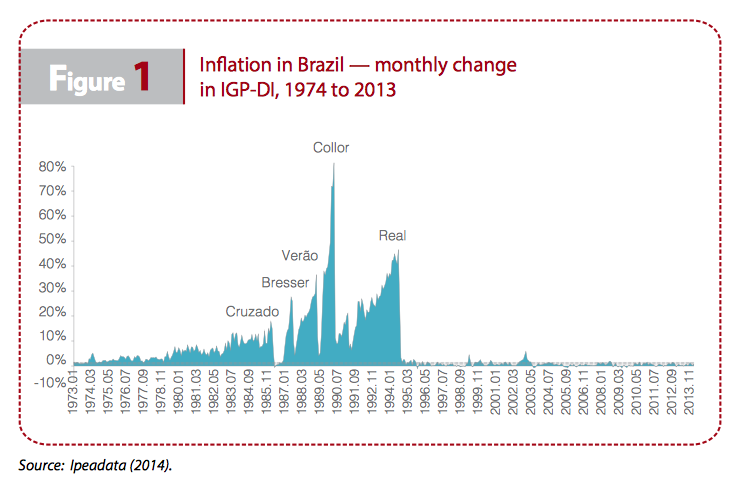
The post-1964 reforms and other policies of the military government, together with the state of the world economy, created conditions for very rapid growth between 1968 and 1973. In that period, the average annual rate of growth of GDP jumped to 11.1%, led by industry with a 13.1% average. Within the industry, the leading sectors were consumer durables, transportation equipment, and basic industries, such as steel, cement, and electricity generation.
As a result of the post-1964 policies, external trade expanded substantially faster than the economy as a whole. There was a significant growth in exports, especially manufactured goods, but also commodities with this came more of foreign exchange money into the market. Although, imports grew considerably fast, rapidly increasing the trade deficit. This did not present a problem, because massive inflows of capital resulted in the balance of payments surpluses.
The external sector contributed substantially to high growth rates, as did the rapid expansion of investment, including a growing share of public investment and investment by state-controlled enterprises. In addition, increased demand for automobiles, durable and luxury goods, and housing resulted from a rapid growth in income for the upper-income strata and from credit plans created for consumers and home-buyers by the capital-market reforms.
The industrial sector generally experienced not only rapid growth but also considerable modernization. As a result, imports of capital goods and basic and semi-processed inputs increased sharply. The share of intermediate goods imports in total imports increased from about 31% in the 1960–62 period to around 43% in 1972, and that of capital goods, from 29% to 42%. The total value of imports rose from more than US$1.3 billion to US$4.4 billion.
A comparison of the 1960 and the 1975 shares of the various industrial sectors in total value added by industry reveals a continuation in the relative decline of nondurable industries, notably textiles, food products, and beverages, and an increase in machinery, from 3.2 to 10.3%. The relative shares of most of the remaining industries, however, did not change significantly in the period.
As a result of the period’s outward-looking development strategy, Brazil’s industrial exports increased from US$1.4 billion in 1963 to US$6.2 billion in 1973. The composition of exports shows that whereas in 1963 processed and semi-processed manufactured exports accounted for only 5% of total exports, in 1974 their share had reached 29%.
In the 1968–73 period, personal income became more concentrated and regional disparities became greater. Industrial expansion took place more vigorously in the Center-South Region, which had benefited most from the import substitution industrialization strategy. Its per-capita income considerably exceeded the national average, its infrastructure was more developed, and it had an adequate supply of skilled workers and professionals.
The region was, therefore, able to take advantage of the opportunities and incentives offered by the military regime. Although a special regional development strategy existed for the Northeast, it promoted a distorted industrialization that benefited only a few of that region’s large cities; the Northeast’s linkages with the Center-South were stronger than its linkages within the region. The combination of a harsh climate, a highly concentrated land-tenure system, and an elite that consistently resisted meaningful change prevented the Northeast from developing effectively.
Thank you.
 Economies of the world